Title V Agency Placement & Project Kansas Department of Health and Environment, Bureau of Family HealthSummer 2024 Fatherhood & Non-Birthing Partner Needs Assessment Internship Focus
During my Title V summer internship with the Kansas Department of Health and Environment's Bureau of Family Health,...
This past April, I had the honor of being selected to present my research poster at the Society for Research on Adolescence (SRA) Biennial Conference in Toronto, Canada. The SRA focuses on advancing understanding of the adolescent developmental period to which my work directly relates. My research poster used the CHAMACOS longitudinal cohort study to determine if early major life events (positive, negative, and neutral) were associated with adolescent mental health outcomes (anxiety, depression, and internalizing issues). At a time when youth mental health challenges are more prevalent...
As a senior in my last semester of the undergraduate Public Health degree, post-grad is looming upon me. While grad school was an option, I knew I wanted some work experience before applying so that I could ground theory in practice. Because of the uncertain future that is just a few months away, it’s been a challenge to not fall into a mental spiral of fear. While I don’t know what this second half of 2026 will bring, I carry a piece of wisdom that Brazil taught me: I should be excited about my future, not dreading it.
When I think about maternal health now, I find it difficult to separate outcomes from experience. In public health, we frequently measure a successful pregnancy and birth using clinical outcomes, but this does not fully capture what the mother had to carry emotionally, mentally, and physically to get there. A birth can look medically positive on paper and still leave a woman feeling unheard, rushed, confused and powerless. I believe that is significant from an MCAH standpoint because maternal health encompasses more than just survival; it also includes emotional safety,...
Informed decision-making is frequently presented as if it is simple: a provider explains, a patient understands, and a decision is made. However, in maternal care, particularly when dealing with immigrant mothers, I have learned that actual understanding is much more complicated. Being informed is not only about receiving medical information; it also depends on how that information is explained, how much time is provided to fully understand it, and whether the patient feels comfortable enough to pause, ask questions and admit confusion. As a doula who works with Latino-...
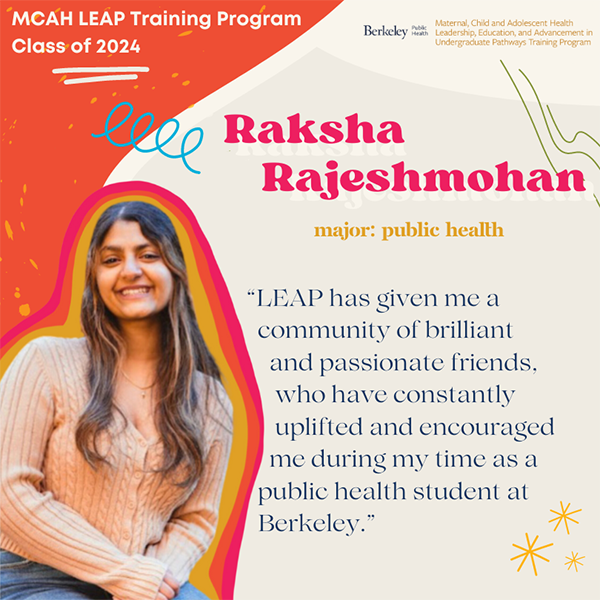
All of the students featured in this section are graduating seniors who are a part of our second cohort of Advanced LEAP Scholars. Read below to learn more about Raksha, Naidelyn, and Angie's, undergraduate experiences at UC Berkeley!
All of the students featured in this section are graduating seniors who are a part of our second cohort of Advanced LEAP Scholars. Read to learn more about Cat, Ivy, and Yucca's undergraduate experiences at UC Berkeley!
Students featured in this section are graduating seniors who are a part of our second cohort of Advanced LEAP Scholars. Read below to learn more about Jaimie and Samantha’s undergraduate experiences at UC Berkeley!
Our faculty has worked with instructors to include MCAH-related content and didactic materials in several undergraduate courses. A few courses are highlighted below. More information can be found on the Berkeley Academic Guide: https://guide.berkeley.edu/courses/pb_hlth/ and academic year offerings can be found on the Berkeley Class Schedule: https://classes.berkeley.edu/
This past summer, I was an intern for Birth By Us, a pregnancy and postpartum app designed to support and empower women and birthing people of color. Birth By Us is a woman-founded organization that centers community-based and equitable maternal care.
My first week as an intern focused on literature reviews related to maternal health inequities, especially those affecting birthing people of color. I also researched existing maternal health apps to analyze gaps in access and designs that Birth By Us could address. Through reviewing platforms such as Mother Goose Health, Health In Her...

 Title V Agency Placement & Project